



What Is a Dual Cylinder Pulverizer and How Does It Work?

A dual cylinder pulverizer is an excavator attachment that breaks reinforced concrete apart and separates the rebar in the same pass, using two hydraulic cylinders to drive one set of pulverizing jaws. That sentence covers the function. The engineering sits in the details: what the second cylinder actually changes, which three numbers on a spec sheet decide whether the tool will survive on a 30-ton carrier, and what happens between the first bite and the last pile of cleaned rubble.
Most demolition crews do not have a problem breaking concrete. The cost sits in what comes after the break, when concrete stays wrapped around rebar, rebar stays matted with concrete, and the pile has to be handled a second time before anything can leave site. A dual cylinder pulverizer is designed around that second problem, which is why it behaves differently from a breaker, a crusher, or a shear.
Key Takeaways
A dual cylinder pulverizer pairs two hydraulic cylinders on one jaw set, generating shearing and crushing force together so concrete and rebar separate at the bite instead of after the pile is made.
Shearing force, jaw opening, and rotation diameter decide what the tool can process; carrier weight, flow, and pressure decide whether the attachment can run at all.
Twin cylinders split the reaction load across two mounting points on each side of the jaw, which reduces bending stress on the jaw body compared with a single central cylinder.
The published working pressure and flow rate are hard limits, not targets. A carrier that cannot deliver both will stall instead of pulverizing.
Wear concentrates in the replaceable jaw plates and teeth, so service life is decided by plate changes and greasing, not by replacing the attachment.
What Is a Dual Cylinder Pulverizer?
A dual cylinder pulverizer is a demolition attachment that clamps reinforced concrete between a fixed jaw and a moving jaw, then applies enough force to crack the concrete matrix and pull it free of the steel inside. The name describes the drive: two hydraulic cylinders, one on each side of the moving jaw, push together instead of a single cylinder working along the center line.
Suppliers list the same machine as a dual cylinder pulverizer shear, a rotating concrete pulverizer, or a hydraulic pulverizer. The label does not change the working principle. When a spec sheet mentions a dual cylinder pulverizer with 360-degree rotation, the jaw set sits on a slewing ring, so the operator can index the jaws to a wall without repositioning the carrier.
The Three Assemblies: Jaw, Cylinders, Rotator
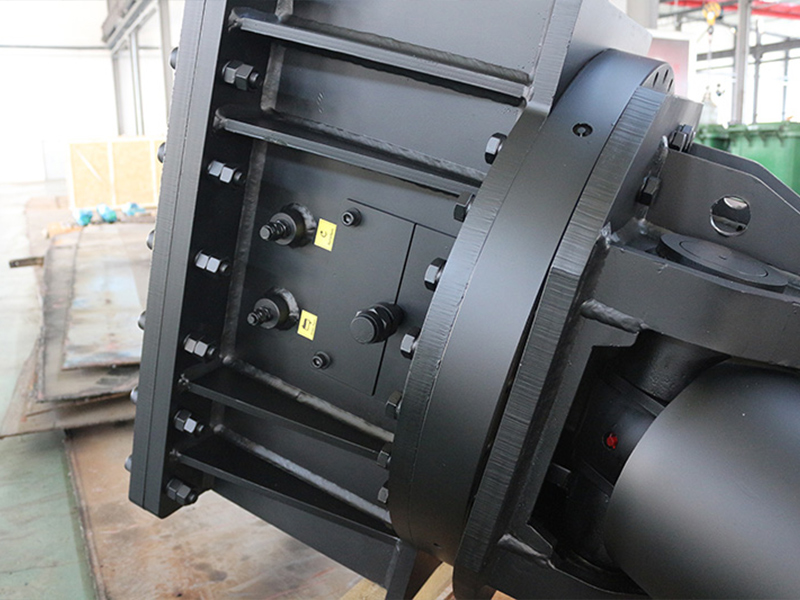
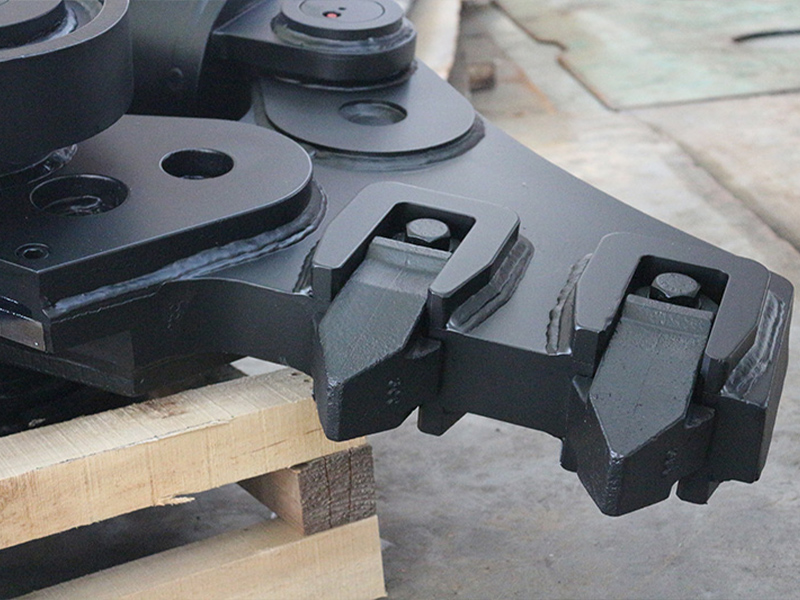
Every dual cylinder pulverizer is built from the same three groups. The jaw group carries the cutting blades at the rear of the mouth and the pulverizing teeth at the front, and both upper and lower jaw plates are normally replaceable. The cylinder group provides the closing force through two rods tied to the moving jaw. The rotator group, when fitted, is a hydraulic motor driving a slewing bearing that turns the whole jaw assembly relative to the excavator stick.
The three groups fail for different reasons. Jaws wear through abrasion, cylinders through seal degradation and side loading, and rotators through grease starvation on the slewing bearing. A dual cylinder pulverizer with worn plates is a maintenance item; the same tool with a dry slewing bearing is a repair.
How It Differs from a Concrete Crusher and a Shear
A concrete crusher uses tall, narrow jaws to crush downward, and it reduces already-broken concrete into smaller pieces. A shear is built around a cutting edge for steel structures. A dual cylinder pulverizer sits between them: its rear blades cut rebar and its front teeth crush concrete, so one tool performs two operations that a crusher and a shear perform separately.
Against a hydraulic breaker the difference is in the load path. A breaker delivers impact energy through a chisel and tends to shatter the matrix, leaving rebar bent and still embedded in a mixed pile. A dual cylinder pulverizer applies slow clamping force instead, so the concrete breaks along the steel rather than around it.
How Does a Dual Cylinder Pulverizer Work?
The working cycle of a dual cylinder pulverizer is short and repeatable: position, bite, crush, separate, rotate, release. Each stage has a specific job, and understanding them in order explains why the attachment is operated at low speed and high force rather than the other way around.
Step 1: Position the Jaw Over the Concrete
The operator opens the jaw fully and places the upper tooth row over the edge of the concrete element, usually a beam, a column stub, a slab section, or a foundation block. The jaw opening sets the upper limit on piece size, which is why a dual cylinder pulverizer with a 1,100 mm opening and one with a 630 mm opening are not interchangeable on the same demolition job, even if both will physically pin to the same carrier.
Positioning is where the rotator earns its cost. On a wall or a slab lying flat, the jaws need to approach perpendicular to the element. Without rotation the operator swings the whole excavator and repositions the undercarriage, and indoors there may be no room. A rotating dual cylinder pulverizer turns the jaw assembly to the work while the carrier stays put.
Step 2: Close the Jaw with Twin-Cylinder Force
As the cylinders extend, the moving jaw rotates about its pivot pin and the mouth closes. The two cylinders act in parallel on the same jaw, so total closing force is roughly the sum of both rod forces at the same pressure. Published shearing forces in this class run from 1,200 kN to 3,500 kN, or roughly 120 to 355 metric tons at the blade.
Two crushing-force figures are normally published for each model, because the force a dual cylinder pulverizer delivers depends on where in the jaw the concrete sits. Force is highest near the pivot and falls as the distance to the load increases, so a piece gripped at the tooth tips sees less crushing force than the same piece gripped deep in the mouth. Reading both numbers is more informative than reading the larger one alone.
Step 3: Crack the Concrete and Expose the Rebar
Concrete is strong in compression and weak in tension, and a pulverizing jaw exploits that difference. The teeth concentrate force into a small contact area, which initiates cracks; the jaw then continues closing and the concrete splits along those cracks instead of shattering into uncontrolled fragments. The rebar inside bends but does not cut, so it stays in one piece and can be lifted out.
This is where a dual cylinder pulverizer separates itself from an impact tool. Slow force applied close to the jaw produces less flyrock and less dust than breaking, and the noise is a hydraulic load rather than repeated impact. On occupied sites and in indoor demolition that difference often decides which attachment goes on the machine.
Step 4: Rotate, Release, and Reset the Cycle
Once the piece breaks, the operator opens the jaw, lets the concrete drop clear of the rebar, and rotates to the next bite. The rebar stays in the jaw for cutting with the rear blades or drops into a separate steel pile. Cycle time is governed mainly by the flow the excavator delivers and by jaw stroke.
An optional differential acceleration valve is offered on some dual cylinder pulverizer models to shorten the no-load part of the stroke, where the jaw closes through empty air before it touches concrete. That modification speeds up positioning without changing the force available at the bite, and suppliers typically quote the gain as a percentage improvement in no-load stroke speed.
Why Two Cylinders Instead of One
Two cylinders do not simply produce twice the force; a single larger bore can match the force at the same pressure. The arguments for the twin layout are structural and operational.
First, load distribution. Two cylinders apply force at two points on the moving jaw instead of one, which shortens the unsupported span and reduces the bending moment carried by the jaw body. On a dual cylinder pulverizer working through reinforced concrete all day, that reduction in cyclic bending stress is what decides frame life, not the peak force figure.
Second, packaging. Force equals pressure multiplied by piston area, so splitting the required force across two smaller bores produces the same total in a lower profile. A lower cylinder stack leaves more room for the jaw geometry and reduces the overall height of the attachment, which matters on indoor work where headroom is limited.
Third, control. If one circuit loses pressure, the jaw does not open freely under load. The trade-off is oil demand: a dual cylinder pulverizer needs more flow than a single-cylinder tool of similar force, which is why flow rate rather than pressure is usually the first limit hit when matching an attachment to an existing carrier.
Need the flow and pressure figures checked against your own excavator before ordering a dual cylinder pulverizer?
Get a QuoteContact UsReading a Dual Cylinder Pulverizer Spec Sheet
Specification tables for this attachment are dense, and most of the columns do not matter at the shortlisting stage. The table below lists the five models in one current production range, with the fields that actually drive a selection decision.
Model | Carrier (t) | Weight (kg) | Jaw opening (mm) | Shearing force (kN) | Crushing force (kN) | Pressure (bar) | Flow (lpm) |
|---|---|---|---|---|---|---|---|
JSDH80 | 6–9 | 535 | 630 | 1,200 | 670/430 | 240 | 150 |
JSDH220 | 12–18 | 1,300 | 900 | 1,900 | 1,120/720 | 300 | 250 |
JSDH260 | 20–30 | 2,190 | 1,100 | 2,400 | 1,460/980 | 320 | 280 |
JSDH290 | 25–35 | 2,470 | 1,100 | 2,400 | 1,610/1,080 | 320 | 280 |
JSDH380 | 30–45 | 3,940 | 1,550 | 3,500 | 2,110/1,380 | 320 | 350 |
Dual cylinder pulverizer specifications as published by the manufacturer. Blade widths for the same range run from 135 mm to 240 mm, and rotation diameters from 360 mm to 806 mm. Pressure and flow are the attachment's own rated values, not the carrier's.
Which Numbers Actually Limit the Machine
Three figures carry most of the decision. Jaw opening sets the largest element the tool can grip. Shearing force sets what the rear blades will cut. Rotation diameter sets the size of the slewing ring and, indirectly, the torque available to turn a loaded jaw.
Two figures are frequently misread. Attachment weight is a stability limit rather than a handling limit: on a small carrier a heavy dual cylinder pulverizer removes lifting capacity at reach. Pressure and flow are not recommendations either. A carrier that supplies less flow than the rating runs the jaw slowly and heats the oil, and one that cannot reach rated pressure stalls mid-bite with a load in the jaws.
Matching a Dual Cylinder Pulverizer to Your Excavator
Matching runs from the carrier outward. The published carrier range is a starting point; the actual fit is decided by three checks made on the machine itself.
Carrier Weight and Attachment Weight
Start with the operating weight printed on the machine plate, not the nominal tonnage in a brochure. A model rated for 25–35 ton carriers belongs on a machine inside that band, and a dual cylinder pulverizer fitted to a carrier at the bottom of the range will feel its own weight in the stick. Check attachment weight against lifting capacity at the working radius, because a pulverizer works at reach more often than below the boom.
Hydraulic Flow and Pressure
Confirm the auxiliary circuit can deliver rated flow and pressure at the same time. Measure flow at the auxiliary ports rather than quoting total pump output, since the auxiliary circuit is set well below the main pump figure on most excavators. A dual cylinder pulverizer rated at 280 lpm and 320 bar needs both values at the ports, with the carrier's relief setting verified against the attachment rating rather than assumed. Return plumbing counts too: undersized return lines throttle the jaw even when the supply side is correct.
Mounting, Rotation, and Hose Routing
Pin diameters, pin centers, and bracket width have to match the stick and linkage, and a pin-on bracket will not transfer to a quick coupler without an adapter. Rotation adds a motor circuit with its own valve section, and the hoses must be routed so they are not pinched through a full revolution.

JSDH80
6–9 t carrier, 630 mm jaw opening, 1,200 kN shearing force.
View Product
JSDH220
12–18 t carrier, 900 mm jaw opening, 1,900 kN shearing force.
View ProductJSDH290
25–35 t carrier, 1,100 mm jaw opening, 2,400 kN shearing force.
View Product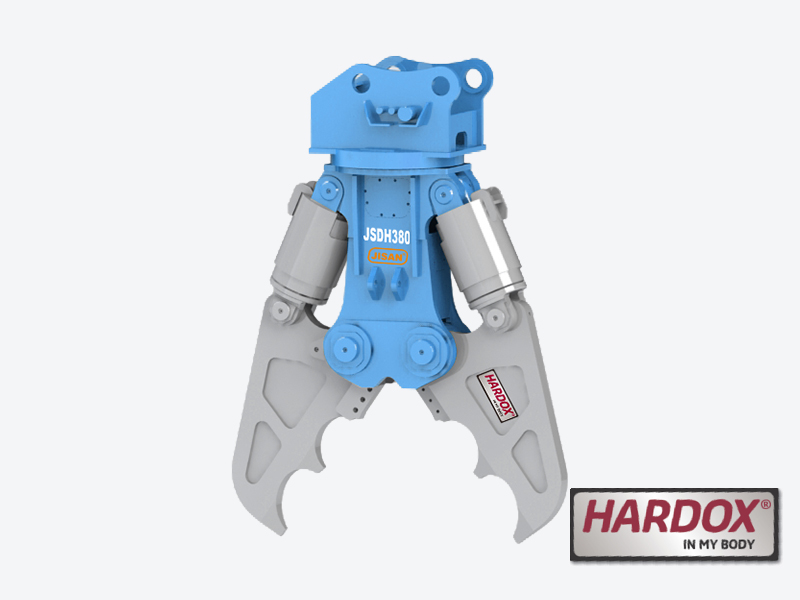
JSDH380
30–45 t carrier, 1,550 mm jaw opening, 3,500 kN shearing force.
View ProductWhere a Dual Cylinder Pulverizer Fits in the Demolition Sequence
A pulverizer is a secondary demolition tool. Primary demolition brings the structure down; secondary demolition reduces what fell into transportable, saleable material. A dual cylinder pulverizer belongs to the second stage.
Secondary Demolition and Rebar Separation
On a typical building teardown, a long-boom excavator or a breaker brings walls and slabs down, and a second machine follows with a dual cylinder pulverizer to break the elements into handleable pieces. The contribution is the split it produces: clean concrete on one side, clean steel on the other. Mixed debris has a low recovery value, and separating at the bite avoids a sorting pass later.
Demolition is also regulated. In the United States, construction demolition safety requirements call for an engineering survey before work begins and for removal of the hazards that survey identifies. Attachment choice is part of managing those hazards, since a controlled clamping tool keeps workers further from falling material than manual breaking does.
On-Site Recycling and Aggregate Production
Concrete free of rebar can be reduced further and reused as recycled aggregate, on site as fill and sub-base or sold on. Industry reference material on recycled concrete aggregate treats it as a workable substitute for virgin aggregate in base layers, and the case for producing it on site is transport cost: material that never leaves the site is never hauled and never bought back as imported stone.
Indoor and Confined Space Work
Inside a building, the constraint changes from force to control. Impact tools transmit vibration into the structure and reach noise levels that stop work in occupied buildings, while a dual cylinder pulverizer works by slow clamping, keeping vibration, noise, and flyrock low. A rotating model suits these conditions because the jaws index to a wall without swinging the carrier in space that may not allow it.
Working out which dual cylinder pulverizer suits a 20 to 35 ton carrier and a reinforced concrete job?
Get a QuoteContact UsWear Parts and Daily Checks
Service life of a dual cylinder pulverizer is decided by four items, all accessible without dismantling the attachment.
The jaw plates and teeth take the abrasion. Upper and lower plates are replaceable on current designs, and replacing them individually keeps cost proportional to wear. Wear plate in the 400 to 500 HB class is typical, and the supplier should state which grade goes on the shell and which on the teeth, because the two are often different.
Pivot pins and bushings take the load. Chrome-molybdenum alloy pins are standard on better-specified attachments, but grease intervals matter more than pin grade: a dry pin in high-grade steel wears faster than a greased pin in ordinary steel. The slewing bearing on a rotating dual cylinder pulverizer is the most neglected item, since it sits out of sight and fails silently until rotation stiffens.
The fourth item is hydraulic. Rod seals degrade with heat and side load, and a weeping seal shows up first as drift when the jaw is held closed under load. A drift check at the start of a shift costs a minute and catches the problem before it scores a rod.
FAQ
What is the difference between a dual cylinder pulverizer and a concrete crusher?
A concrete crusher uses tall jaws to reduce already-broken concrete into smaller pieces. A dual cylinder pulverizer combines rear cutting blades with front pulverizing teeth, so it cuts rebar and crushes concrete in the same bite, which makes it a separation tool as much as a reduction tool.
Can a dual cylinder pulverizer cut rebar?
Yes. The rear blades are designed to shear rebar, and published shearing force for the range above runs from 1,200 kN to 3,500 kN. Maximum rebar diameter cut cleanly depends on blade condition as well as force, so confirm it with the supplier for a specific model.
What excavator size does a dual cylinder pulverizer need?
Current models cover 6 to 45 ton carriers in overlapping bands: a 6 to 9 ton machine takes the smallest, a 20 to 30 ton machine a mid-range unit, a 30 to 45 ton machine the largest. Auxiliary flow and pressure matter as much as weight class.
How long do the jaw plates last?
Life depends on concrete strength, rebar density, and how much work is spent on abrasive material. Suppliers publish a service interval in operating hours for wear plates and support individual replacement, which is the practical way to control cost per ton processed.
Should a dual cylinder pulverizer be fixed or rotating?
A rotating unit suits indoor demolition, wall and slab work, and jobs where the carrier cannot be repositioned freely. A fixed unit is adequate outdoors on stockpiled rubble where the machine can swing to the material. Rotation adds a circuit and a wear item, so fit it only where the working pattern needs it.
Conclusion
A dual cylinder pulverizer answers a specific problem in demolition: how to break reinforced concrete and free the steel in one controlled operation rather than two. Two cylinders driving one jaw set give the attachment its force, its lower profile, and its ability to split the reaction load across the jaw body, while the rear blades turn the same bite into a rebar cut.
Read the spec sheet in order. Jaw opening first, to establish what the tool can grip. Shearing and crushing force second, to establish what it can break. Pressure and flow third, to establish whether the carrier can run it. Attachment weight last, to establish whether the machine can still lift it at reach.
If you are sourcing a dual cylinder pulverizer manufacturer for a demolition or recycling fleet, JISAN Heavy Industry builds the JSDH range for 6 to 45 ton carriers, with Hardox wear steel, replaceable jaw plates, and a matching check against your excavator's auxiliary circuit before shipment. Send the carrier model and the working conditions, and the specification can be confirmed against a real machine rather than a catalog range.
Please Contact Us!
Recent News
1.JISAN Heavy Industry Debuts at the 2026 Las Vegas Construction Machinery Exhibition | Shining on the Global Stage with Hard Core Components
2026-05-082.Choosing Between Hydraulic and Mechanical Scrap Shears
2026-09-043.How JISAN 4-Core Attachments Boost Demolition & Recycling Output 30%
2026-09-104.How to Match a Hydraulic Breaker to Your Excavator
2026-11-19


